
Introduction
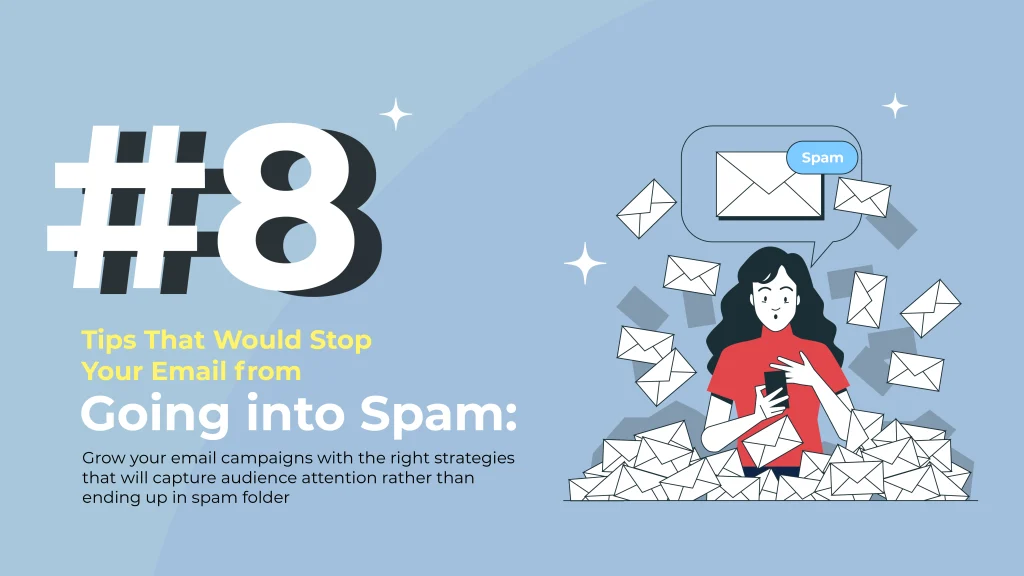
Email, a key marketing strategy, doesn’t always bear the fruits the business desires. It could be because the email blast your business is sending out is not being seen; it is directly landing in the spam folders.
How do you stop it? The few things you can do are mentioned below in the infographic that will prepare you with email best practices to avoid spam.
Clean Email List
1. Cost saving
2. Better email deliverability
3. Increased engagement
Subject Lines
Subject lines are essential to stay away from spam folders as they are first thing recipients check out when they receive an email. Your subject line shouldn’t be in all caps or have too many exclamation marks or spammy words (100% More, 100% Free, 100% Satisfied, etc.).
To write the best subject lines, here are a few tips so that your email can get past the 69% of recipients who are not impressed with a poorly written subject line.
1. Short and Simple Subject Line
2. Use Personalization
3. Add Numbers
Unsubscription Option
1. Reach the inbox, not the spam
2. Gaining feedback
3. Putting an end to Customer Frustration
4. Create Segmented Email List
When you use tags in the email marketing platform to segregate a list of subscribers into different groups, it is called email segmentation. It has several benefits; for instance, the un-segmented email campaigns have a higher unsubscription and bounce rate, which is reduced by 9.37% and 4.65%, respectively, with segmented email lists. On the same grounds, there is a significantly reduced abuse report (3.90%) and bounce rate (4.65%).
These are some of the very promising benefits of email segmentation, but the benefits of email segmentation don’t end here. Below, we have listed a few more benefits.
When you want to maximize the returns of your email campaign investment, a segmented email list performs better in the areas of open rates and clicks.
- Open rates: When you have segmented the email list, the personalization factor of the email goes up, hence the likeliness of the email being opened by the target audience. The average open rate goes up by 31% and the unique open rate by 10.64%.
- Click: When the open rate increases, the clicks on the email also increase. With email tracking technologies, you can accurately determine how many times the writer has interacted with the email and proceeded to further actions. Statistics suggest that segmented email list clicks go up 95%.
5. High- Quality Content
High-quality email content ensures that email doesn’t get marked as spam. The email service provider and the internet service provider analyze the content of the email.
Apart from the email being scrutinized by the service providers, the recipients of the email, if they find the content misleading, poor quality, and irrelevant, they can flag the email.
Even with a load of sophisticated email marketing tactics, if the content is not created with clarity, consciousness, and value proposition, it doesn’t add any to the target audience’s requirements. If the email content is not personalized, the unsubscription rate can be 52% percent, whereas if it is personalized, it can have a click-through rate of 27% and a heightened engagement rate of 74%.
Email Frequency
The frequency at which the emails are sent can make or break the success of your campaigns. The rate at which you intend to send emails must be right, as 74% of people are usually overwhelmed by email overload.
When brands send out emails indiscriminately without relevance, recipient engagement, and timing. It leads to a few significant challenges, as mentioned below.
- High Spam Risk: 44% of people spend their time clearing junk email at work, and these stats clearly highlight the fact that any business that has sent too many similar emails too many times will get flagged.
- Low Engagement: When too many emails are sent continuously, they get ignored and deleted. The click-through rates and the open rates are heavily affected.
- Negative brand perception: When businesses drop into your client’s inboxes way too frequently, their business reputation ends up taking a bad hit. Most of their clients start considering their business unworthy and intrusive.
Focus on the Address from which You Send Email
94% of the clients become loyal to a brand when they are provided full transparency, and it also determines whether their email will be opened or not. This makes it vital for a business to choose a consistent “from” name and email address.
61% of people like receiving promotional emails all week, and 38% don’t mind receiving promotional emails even more frequently, which is why it makes sense to choose a title that is recognizable by your subscribers. It is your company name or the product or service they have chosen to subscribe to.
Apart from these reasons, the “From,” “To,” and “Reply-To” have to be accurate for compliance guidance for business as per the “CAN-SPAM”/ “GDPR Act.
Let Go Attachments
Actual spam emails have harmful attachments, which is why businesses sending emails with attachments can trigger spam filters. The service providers and spam filters pick up on these emails as 1.2% of the emails sent are malicious, and 1 out of 4,200 always end up in a phishing scam.
In some cases, the spam filters are even designed to remove emails with attachments, and in some cases, the spam filters get triggered depending on the size of the email.
To avoid getting picked up by the spam filter, include all the necessary information in the body of the email, as Google itself blocks 100 million phishing emails every day. If you want to add additional material, then use links rather than attachments.
Follow these email best practices to avoid spam folder once and for all.