Introduction
Consider this scenario: Imagine you are the founder of a business, and your team has meticulously crafted a ‘killer’ content strategy that you know is going to be the cherry on the cake. You are super confident that your plan is going to be a grand success and bring in more customers, thereby multiplying your sales and catapulting your fame in the industry.
To your immense surprise, you find that the ‘killer’ content strategy has not nailed the wall! You feel disappointed, start picking your team to work out new content. But what if we tell you that the actual problem does not lie with your content?! Without proper ideation, what if we tell you that your strategy has failed to tick a few checkboxes and has fallen flat by bringing in low traffic and fewer engagements?
The answer is simple—you need to know how to promote your content. Forget about marketing strategies for once! It’s time to identify your target audience and ensure your content matches their expectations. This might require a new approach, a shift in perspective. Let’s talk about content promotional strategies that can actually make the audience read and resonate with your content, thereby improving your ranking and achieving conversions.
What Is Content Promotion Strategy?
Content promotion refers to the process of distributing content through online channels, such as paid ads, SEO, social media, etc. The ultimate objective of a content promotion strategy is to resonate with your target audience so that they view your content, thus increasing visibility, boosting engagement, and driving sales and business growth.
Over 57% of marketers have identified ideating content as their biggest challenge, whereas a whopping 91% of them (B2B) have indicated content marketing as their go-to strategy to reach customers. All these data come down to a single point—content is the undisputable ‘king’ for any business to thrive!
Why Content Promotional Strategy Is Important?
Increases Content Visibility and Engagement
Your content is just a speck in the sea of content published every minute. To make your content stand out from your competitors, you need an ‘awesome’ content promotional strategy that will resonate with your target audience and carry forward your intended message.
Content promotion strategy not only helps you to identify your target audience but also paves the way for them to reach out to you by way of likes, shares, comments, and mere clicks. The rapport you build with your audience helps carve a niche for you and promote your business.
These tactics will bring traffic to your website, increase your search engine rankings, help you achieve potential sales, and maximize your profits.
Generate leads and conversions
Builds Brand Awareness and Authority
Challenges Faced By Businesses Who Do Not Have A Proper Content Promotion Strategy
a) Reduced Visibility and Engagement
b) Wasted Resources
c) Poor Brand Reputation
d) Low Search Engine Rankings
e) Lack of Measurable Success
f) Ineffective Customer Relationships
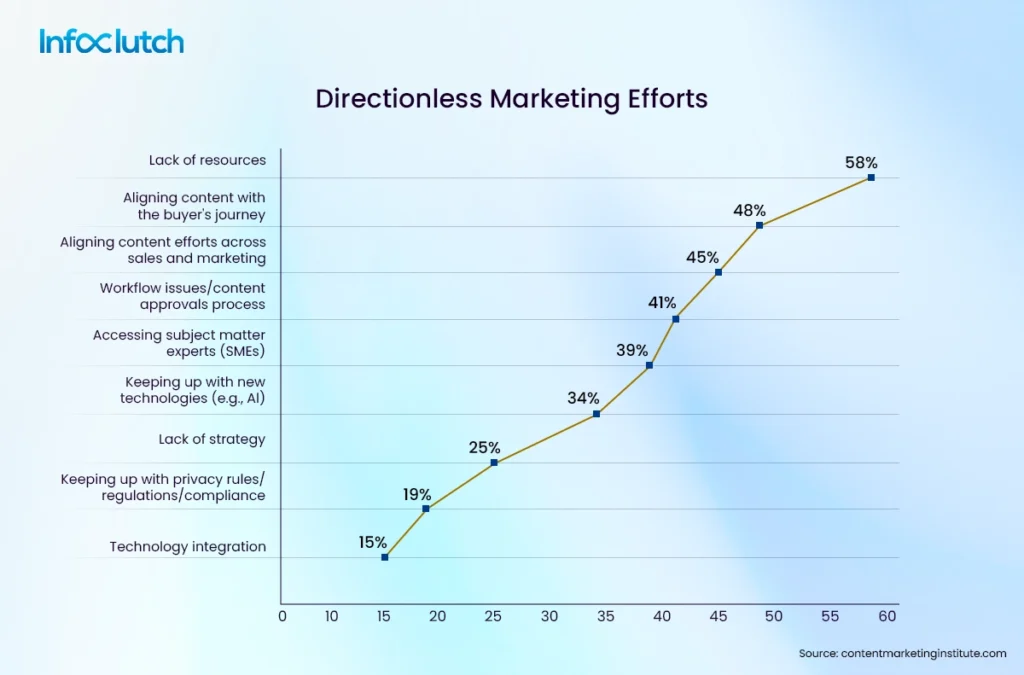
g) Directionless Marketing Efforts
A lack of coherent marketing strategy often results in directionless results, where campaigns are disjointed and out of focus. This can lead to confusion among potential customers about the brand’s offerings and value proposition.
The graph indicates the challenges faced by B2B content marketers face, if they do not have a proper content promotion strategy in place.
Setting The Foundation For Good Content Strategy
A business can’t flourish if the way forward is not clearly identified. The content field is a tough nut to crack. Unless you are able to articulate your thought process into what exactly you wish to achieve, it will be extremely difficult for you to navigate into the world of content, which will fail to boost your business the way you had envisioned!
The following pointers help you understand what you, as a business owner, need to do to create a good content promotional strategy.
Define your goals
a) Identify specific, measurable objectives
When setting content promotion goals, it’s essential to make them SMART: Specific, Measurable, Achievable, Relevant, and Time-bound. For example, instead of a vague goal like “increase website traffic,” a SMART goal would be “increase customer engagement by 35% within the next six months.” This approach provides clarity and allows for effective progress tracking.
But if you expect overnight success and start publishing content for all the wrong reasons, your business is bound to fail before it can take off! So, keep in mind that your goals are within reach, and you don’t go overboard during the planning stage.
b) Align promotional goals with overall business goals
Your content promotion objectives should directly support your company’s broader business goals. For instance, if your company aims to increase organic web traffic by 5% in the next three months, your content strategy might focus on generating high-quality leads or improving conversion rates. This can indeed change the perspective of your business goals.
Once your KPIs are clear, you can alter your content strategies to suit the needs of your buyers and promote content that actually resonates with your audience.
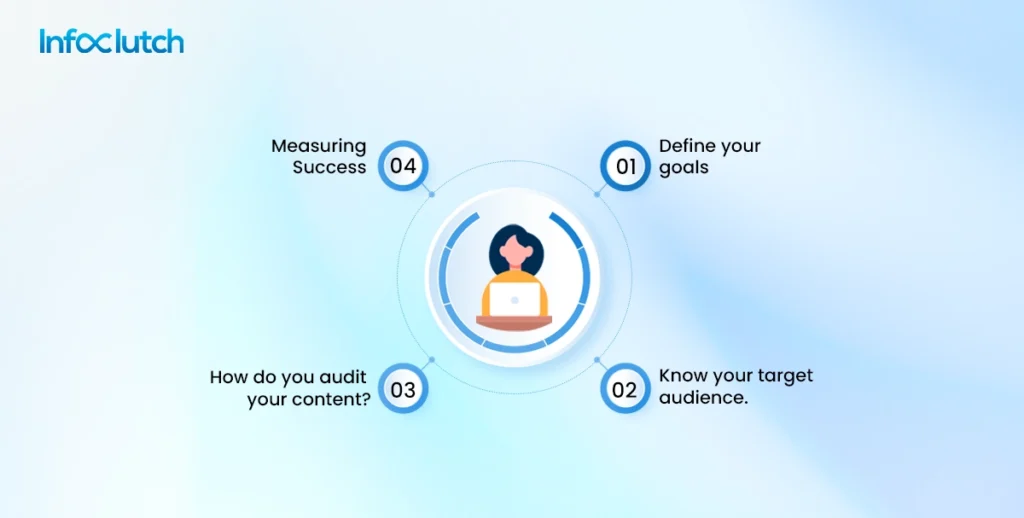
Know your target audience.
a) Create detailed audience personas
So, you have identified your goals. But how will you leverage your content to the right target audience? Have you understood what they actually want, and will your business be able to provide an answer to their problems? To understand your customer profile, you have first to ask yourself these questions:
- Is your product/service able to satisfy the needs of customers?
- Is your product/service able to understand customers’ pain points and offer the right solution to them?
- Can you audit your existing resources and understand the areas where you lack?
- Are you able to do a competitor analysis and analyze the gaps where you have missed and how they are able to outperform you?
Develop comprehensive profiles of your ideal customers, including demographics, interests, pain points, and content preferences. These personas will guide your content creation and promotion efforts, ensuring that you’re targeting the right people with the right messages.
b) Understand audience preferences and behaviors
What works for one business may not work for another. The process is going to be long, with plenty of trials and errors. Once you understand the platforms and the variations of content that they are truly interested in, you will be able to make informed decisions.
For example, 30% of your target audience may prefer ‘Facebook,’ and you will have to post content that appeals to your chosen audience. Your content will backfire if you try to churn out the same formula for audiences who prefer ‘Twitter.’ A few simple ways by which you can understand your audience’s tastes and preferences are:
- Conducting online polls and surveys
- Identify the type of content that they usually like to watch by checking out their purchase history and demographics, including their age, gender, location, income level, and interests.
- Do a thorough competitor analysis and try to fill the gaps of the missed pointers, etc.,
Research how your target audience consumes content, which platforms they prefer, and what types of content they engage with most. This information will help you tailor your promotion strategy to reach your audience effectively.
How do you audit your content?
a) Analyzing top-performing content
b) Identifying gaps and opportunities
You may think that writing and publishing content in all platforms is sufficient, but hey, it’s not. Not all content is successful when it comes to measuring their effectiveness. You have to learn to refresh your content constantly every time, and this might be challenging. How can you do it? By conducting a content GAP Analysis.
Marketers often perform content gap analyses in digital marketing to understand why a particular piece of content is failing to deliver the intended results. The following few pointers ought to help you understand the basics of GAP analysis:
- It enables you to assess content that is underperforming. Any content that fails to bring engagement is a lost opportunity.
- Research the list of keywords and perform a competitive analysis to understand what you’ve missed.
- Prioritize high volume keywords to rank according to search volume, relevant to your business, etc.
- Update content regularly by creating new content to fill out the existing gaps and republish them.
- Perform the GAP analysis at least once in six months to determine if your business is steady or stagnant.
Measuring Success
a) Tracking your KPIs
KPIs, otherwise known as Key Performance Indicators, quantify the performance of businesses or individuals by creating set parameters to help them achieve their objectives. Choose KPIs that align with your strategic objectives
Given below are some of the best practices for monitoring KPIs for content creation:
- .Achieving ROI in terms of sales or customer subscriptions
- A track on new leads and new people who have signed up on our website
- Driving traffic to your website and calculating footfalls per day.
- The time spent by customers who read your content (Also known as Retention Time)
- Measuring the engagement rates after you publish new content online.
b) Use analytical tools to measure your progress
c) Adjust strategies based on data insights
d) Continuous Testing and Optimizing Content
Content Promotion Strategies That Actually Work
Social Media Marketing
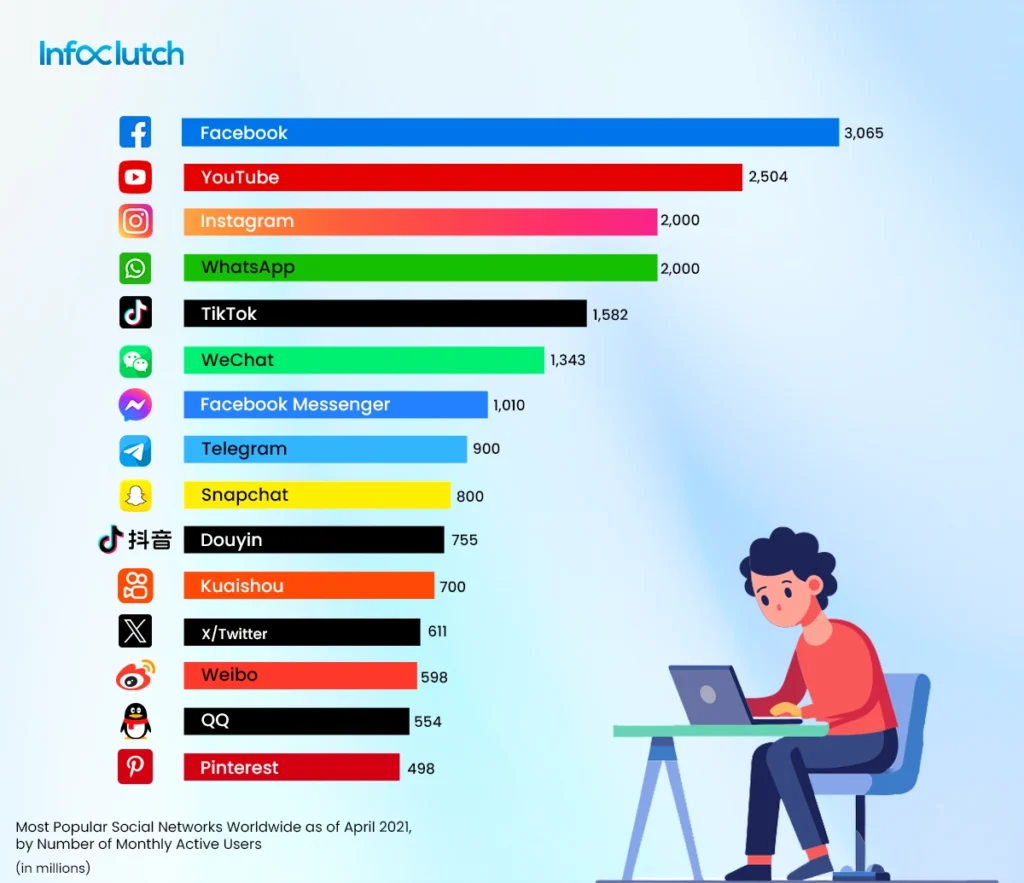
a) Select the ‘right’ social media channel
Wanting to promote your content on social media may seem easy, but it’s not! How can you go about identifying the right channel for your business? With content overflowing on each channel, spotlighting your content may seem arduous.
But don’t worry! You can declutter and single out your content by way of a few well-placed strategies, like researching your target audience’s most preferred channel. Every social media platform has its own set of algorithms.
Plan out your content promotional strategies so that your content reach all channels using an interspersed mix of visuals, infographics, videos, reels, carousels, and static content.
b) Focus on Engagement
So, you have curated a wonderful content promotional strategy and have leveraged all the social media channels. Are you congratulating yourself for the job done?! Surely you are mistaken! Merely posting on social media is of no use. You must also engage with your target audience regularly by:
- Replying to your audience’s comments promptly
- Taking an active part in conversations
- Organizing Q&A sessions by encouraging your target audience to reach out to you
- Use fun posts such as memes and gifs to pique their interest in your offerings.
c) Using relevant hashtags
Every content that you post on social media needs to have relevant hashtags. These hashtags play an important role in helping your audience to find you easily. Always use hashtags to promote the content that you are trying to publish on the social media platform. Hashtags should be used as a tool to provide additional information about your post.
For instance, if you are posting on Instagram, you can add a mix of prominent hashtags and some of your own. Adding more than 3-5 hashtags doesn’t mean that your content gets distributed evenly. Most marketers often think that the more hashtags they use, the more engagement they will get. In reality, overstuffing your content with more hashtags can bring you more harm than intended.
Email Marketing
Social media is not the only way to apply content promotional strategies. Once you have captured the interests of your target audience, the best way to retain their interest is through email marketing. And for that, you need to have an extensive contact database as your marketing tool to craft a ‘killer’ content promotional strategy.
With a compelling heading and a catchy CTA (Call to Action), you can easily win over your customers and build a loyal base via email marketing.
There are many things that you can do to attract your existing customers, bring in potential customers, or for those who are still in the deciding stage. So, here is what you can do once you get your personalized list of subscribers:
- Offering sample/free products
- Loyalty programs
- Contest announcements and giveaways
- Newsletters and interesting snippets about your business
- Exclusive information about your upcoming products/services and many more.
Content Optimization for Search Engines (SEO)
Did you know that optimizing your content helps you reach out to a larger and more relevant customer base? A recent study conducted by Google revealed that 53% of people in the U.S. say that they research products on search engines before purchasing to ensure they are making the best decision possible. The logic is simple – the higher your content ranks on Google search engines, the more customers are likely to click and engage.
Before we get into the finer aspects of SEO, let us first understand the three types of SEO that are readily available:
On-Page SEO
Off-Page SEO
Technical SEO
Paid Advertising
Paid advertising is one of the quickest ways to rank your content higher in search engines. Paid advertising consists of how you pay search engines to promote your content – the process is called bidding, and the more you bid and outgrow your competitors, the more chances you get to rank your content in the first top ten rankings of the search engine.
The competition will be fierce, and you will have to keep up if you want to be in the top box. Here are a few ways to leverage paid ads for your business:
Using Pay-per-Click Advertising
This is one of the most effective methods that allows you to display ads on search engines and other channels. The USP of pay-per-click is that you get to pay only what the customers have clicked to view your ad.
One of the biggest advantages of PPC ads is that your content gets noticed instantly, thereby creating a brand awareness that helps you assess your returns on investment (ROI). Try using extensive keywords that can help maximize the success of your business.
Experiment with social media ads
Social media ads offer multiple advertising options to entice your target audience. Advanced targeting capabilities based on interests, behaviors, and demographics make it easier to connect with potential customers.
Various ad formats, such as image ads, video ads, and carousel ads, provide creative opportunities to engage users. These ads help you define your campaign objectives and categorize the placement of ads for specific goals such as lead generation, sales, visibility of business, etc.,visibility of business etc.
Retargeting visitors
This method allows you to display ads for existing customers who have visited your website previously. For instance, a customer may have visited your website but not purchased anything. Social media ads play a crucial role by popping up continuously to customers who have visited your website or have previously been acquainted with your brand.
The key benefit of social media ads is to re-engage customers who were previously interested in your brand and your offerings. This can increase your brand’s recall value and result in higher conversion rates.
Monitor your ad’s performance
Paid ads also involve continuous monitoring of your KPIs, such as click-through rates, conversion rates, and ad costs, to ensure that your objectives are precise and clear. This helps you keep track of your performance, determine whether your campaign ads resonate with the target audience, and find ways to improve if they are not at their best.
You can use A/B testing to check the effectiveness of your elements, such as meta descriptions, keywords, image creatives, and CTAs. At the same time, monitor your bids, ad spends and allocated budgets to review and refine your parameters, which will help ensure the overall success of your paid ads.
Influencer Partnerships
It’s not just about how you promote your content. Who you promote your content with plays a significant role in helping you reach your customer base. And that’s where influencer partnerships come into the picture. Influencers play a major role in making or breaking any product/service, and this holds in all cases.
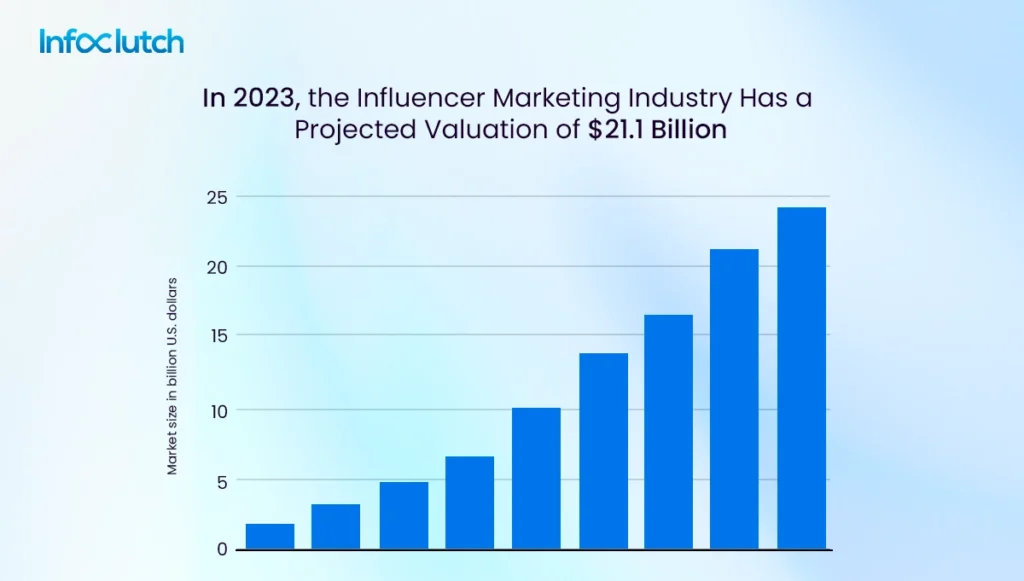
If you want a good social image, you will have to work with collaborators, otherwise known as influencers, who will team up with your brand to market your offerings on your behalf. These influencers will have loyal followers, and they help build meaningful relationships with your customers and help promote your brand using their knowledge and expertise.
How will you know which influencer can help generate leads for your business? Understand that there are four types of influencer partnerships based on followers, namely:
- Nano influencers who have 1-10k followers
- Micro-influencers who have 10k -100k followers
- Macro-influencers who have 100k-1 million followers and
- Mega Influencers who have more than 1 million followers
Your objective is to choose an influencer who will add value to your business. Based on your budget and the content you wish to promote, you can select the right influencer for your brand.
Content Syndication
Do you feel that your content is not getting the projected likes and subscriptions, even though you followed the strategy to the ‘t’? If that’s the case, then all you have to do is promote your content through a syndicate.
Content syndication refers to churning out published content to bigger websites to maximize customer engagement. This method allows your content to reach a wider audience base. You can syndicate any form of content, such as blogs, podcasts, videos, social media posts, and more.
The benefits of syndicating your content are:
- Increased customer reach will help expand your content to a larger audience and boost your brand’s visibility.
- Republishing your latest and most popular pieces of content on prominent guest sites such as Medium, BlogSpot or LinkedIn can help you get the maximum engagement.
- Syndicating your content can help build backlinks and eventually increase search engine rank.
- Content syndication is one of the core aspects of lead generation.
Cross-Promotional Activities
Cross-promotion refers to collaborating with one or two businesses for mutual benefit. Any two or more companies can cross-promote their offerings to reach their target audience. For instance, if your business is in the fintech space, you can cross-promote your services to payment gateways and banks and vice versa.
You can cross-promote other businesses by way of joint webinars, podcasts, marketing events, etc., by offering complimentary products (merchandise) or sponsoring the products to reach a combined audience.
Repurposing Content
Have you ever wondered why certain pieces of content did not reach your targeted audience? The content may not have been appealing enough for your audience. The solution to this type of scenario is to repurpose your content to a different format so as to match your audience’s wavelength.
To put it simply, the process of repurposing content into an alterable format is called content repurposing (content recycling). This involves changing and rewriting old content to a form that suits the tastes and preferences of your target audience. For example, if you feel that your carousel post is not getting targeted engagement, rewrite and convert the same post as a video or a reel and watch your engagement grow.
Here are some key benefits of repurposing your content:
- It helps increase your content to go viral as you adapt it to different formats.
- You can not only attract an old audience, but repurposing can help bring in new people to your brand, thus widening your target base.
- By creating multiple formats of the same content and publishing them on different sites, you can cut down costs, as you are just reusing the same content everywhere.
- Your content remains fresh and evergreen in the minds of your customers, as they can view the same content on every platform.
Interactive and Visual Content
Start publishing content that keeps your customers wanting more! How can you ensure that your content lingers in people’s minds? By bringing in interactive content. This subtle art of adding key elements that encourage your audience to participate is called interactive content. Polls, quizzes, image comparison slides, hover animations, and clickable hotspots are some of the best examples of interactive visual content.
According to a report, 88% of marketers say interactive content is effective at differentiating their brand.
The benefits of using interactive visual content are multifold. Here are a few to highlight:
- Using creative visuals, you can capture the interest of your audience to participate, ask questions, and collaboratively come to a solution quickly.
- Interactive visual content is one of the most powerful tools for gaining higher conversions.
- Easily gather data about your customers’ tastes and preferences.
- By creating engaging content, you can achieve your business goals easily.

Top Content Promotional Tools To Use
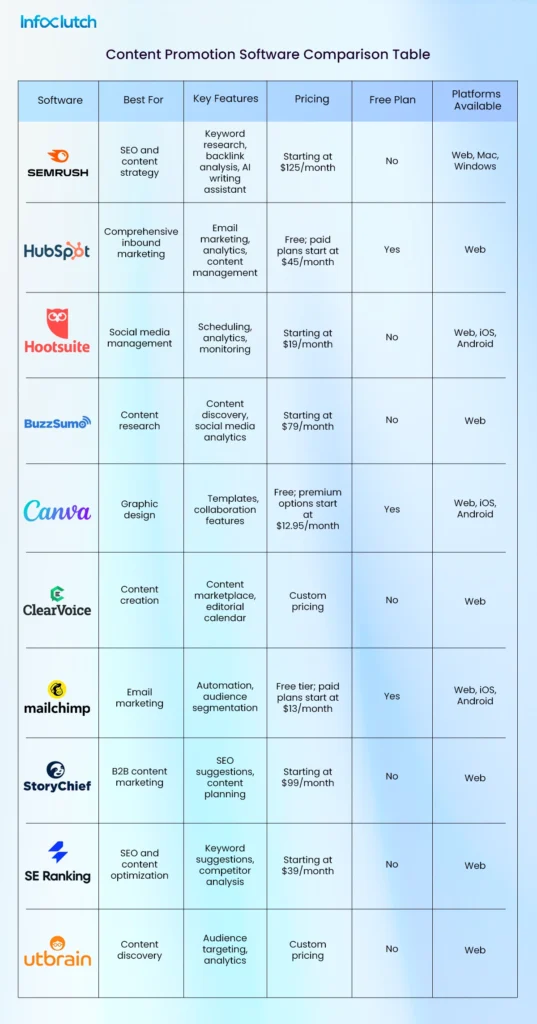
Irrespective of the content promotional strategy that you have used, your content cannot promote itself without proper content promotional tools. Each tool has been carefully researched based on its functionality, user experience, scalability, and how well it provides support to businesses.
The tabular column below gives an overview of the best content promotional tools that you can use to elevate your business.
Key Takeaways
1. Stay Consistent in your efforts.
2. Measure and analyze your content.
3. Stay updated about current trends.
4. Experience and experiment.
5. Quality is Paramount
Ensure that creating high-quality content is of utmost importance as it helps reach your target audience. By combining these, you can build a great strategy to promote your ‘killer’ content online.
Conclusion
This blog brings out the best strategies and tools that you, as a business owner, can use to accelerate your growth in the digital landscape. Rather than stick to one plan, it is always advisable to use a multi-faceted approach that provides the advantages of various channels and strategies. As a B2B industry, you will have to ensure that one-size doesn’t fit all.
To ensure that you get the perfect marketing data, you will have to figure out who your target audience is. These, put together, can help scale your business by reaching your target audience, amplifying your brand’s voice, bringing out more conversions, and, ultimately, spearheading your sustainable business growth.
In the end, it’s all about continued efforts and perseverance. Success doesn’t happen overnight. Review and filter your strategies regularly, and you can watch your business grow gradually. As you implement these strategies, keep in mind that focusing on building relationships with your audience is the crux, as this will be the stepping stone for any business to achieve long-term acceleration and success.