Introduction
AT&T (American Telephone and Telegraph Company) is a Dallas-based company that specializes in telecommunications and technology. Its history dates back to 1876 and Alexander Graham Bell’s invention of the telephone.
It was previously known as “Ma Bell.” It was a monopoly that helped build much of the United States’ long-distance telephone services.
The Inception
1870s - 1970s
Alexander Graham Bell and another inventor, Elisha Gray were working on similar telephonic devices. They each filed patent documents in Washington, D.C., on February 14, 1876, on the same day.
Bell was granted Patent US174465A on March 7, 1876, and has been called the father of telephony. They launched the Bell Telephone Co., which was formed by Bell and two investors, Gardiner C. Hubbard and Thomas Sanders, in 1877.
Bell underwent some legal tussles in the following decade, and it was not until 1885 that AT&T was formed as the Bell Telephone & Telegraph Co., responsible for creating long-distance telephone lines.
1926
1929
1947
1954
1969
1972
1974 - 1984
In 1974, the U.S. Department of Justice set out to take the monopoly. It took a full decade to conclude an agreement that compelled AT&T to divest itself and become a separate entity.
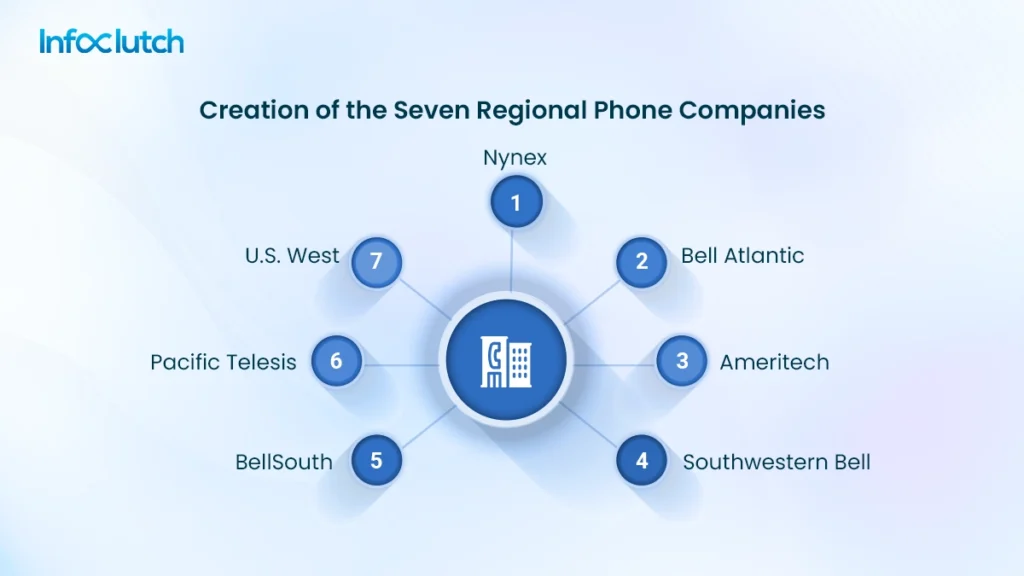
That was the end of Ma Bell’s reign. The operating companies were all disconnected from Ma Bell and were created into seven regional phone companies.
Creation of the seven regional phone companies
1996
AT&T again broke up after the decision by the company’s chair and CEO, Robert Allen. He divided the company into three separate entities. It was the largest corporate breakup in history.
- AT&T Corp provides long-distance telecommunications services.
- Lucent Technologies produced marketed telephones, computer chips, and other hardware.
- NCR Corp manufactured computers, electronic cash registers, and other data-processing systems.
Two years after the dismantling became official, Edward Whiteacre was named chair and chief executive of Southwestern Bell. He started his telephone industry career doing repair work in Texas.
In 1995, Whiteacre transformed the Southwestern Bell name to SBC Communications Inc. In the next decade, he focused on rebuilding what the Government had torn apart. SBC merged with AT&T Corp. The merged company would be called AT&T.
2007 – 2020
Randall Stephenson was another chief executive who wanted to reform AT&T. He worked his way to the top through the finance division and was named finance chief before becoming chief executive in 2007.
Stephenson’s tenure involved acquisitions where some were good, some questionable, and some bad. The agenda was to diversify and accelerate the size of the company.
In March 2011, AT&T launched a $39 billion takeover of T-Mobile (TMUS) that would become the largest cellular carrier in the U.S.
Five years later, he ventured down another path, which was the media and entertainment industry. He planned to combine AT&T networks with Time Warner’s.
2016 - 2022
In late 2016, AT&T declared its plan to merge its broadband and wireless networks with Time Warner’s film and animation, which ranged from HBO and CNN to Harry Potter and other superhero franchises.
However, the deal faced obstacles from the beginning, including an antitrust suit. After months of negotiations, a district judge sided with AT&T and pushed the deal through. It shut down in 2018.
The next four years took a topsy-turvy turn. There was a cultural crash between AT&T and Time Warner.
In 2020, Randall Stephenson retired and handed the company over to John Stankey. He sold off pieces of the company to focus on the future.
By May 2021, AT&T announced it would spin off WarnerMedia, which would merge Discovery’s reality cable and television channels.
In 2022, AT&T decided to sell WarnerMedia’s entertainment division to Discovery, Inc. At a sale price of $43 billion, AT&T recouped only half of what it had paid to acquire WarnerMedia just four years prior.